
If you’ve ever stood barefoot on a cold kitchen tile, you know it’s uncomfortable. Now imagine standing on a literal block of ice for six hours. That is basically the daily life of a duck or a penguin. So, why don’t their feet freeze off? And why doesn’t that freezing blood from their feet cool down their whole body and give them hypothermia?
The problem: heat loss
Normally in the body, arteries and veins are just… pipes. Arteries carry warm blood away from the heart, and veins carry cooler blood back to the heart. In humans they’re often separated – it works great (unless you stand on ice for hours).
If a duck’s leg worked like this, warm blood would travel down to the foot, heat would be dumped straight into the ice and ice-cold blood would rush back to the body.
And well, cold blood = lowered core temperature, and we all know how that would end…
The solution: heat swap
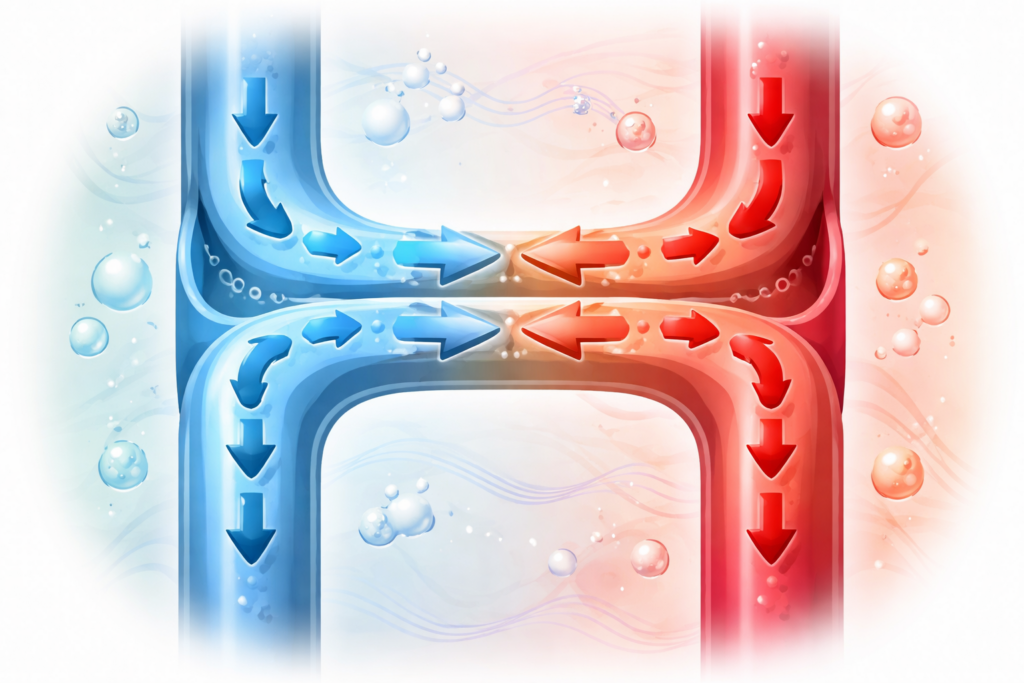
Instead of running arteries and veins separately, ducks (and penguins, whales, seals etc.) bundle them tightly together.
And instead of the blood flowing in the same direction, they flow in opposite directions. That’s where the “countercurrent” comes from! The warm blood in the artery moves down toward the feet, and cold blood flows in the vein back up the body.
Because the artery and vein are so close together, heat doesn’t wait until the blood reaches the foot to escape. Heat actually moves from the warm artery directly into the cool vein across the leg – so the artery slowly cools as it goes down, and the vein slowly warms as it goes up.
The Result?
By the time the blood reaches the duck’s foot, it’s already relatively cool, so it doesn’t lose much more heat to the ice. And by the time the blood traveling up the vein reaches the duck’s body, it has been pre-warmed by the artery.
The duck’s feet stay just above freezing (enough to keep the cells alive), but its heart stays nice and warm.
It’s not just about heat!
This principle is a “Universal Principle.” It doesn’t just work for heat; it works for oxygen and waste products too.
In fish gills, water flows one way, and blood flows the other. This ensures that oxygen is always diffusing into the blood, making fish way more efficient at breathing underwater than we would be.
In your kidneys, your body uses this same trick to concentrate urine so you don’t dehydrate!
And in dialysis machines, engineersuse this exact physics principle to clean a patient’s blood. They run the cleaning fluid (dialysate) in the opposite direction of the blood, and they can pull out way more toxins than if they ran them in the same direction.
Cool. Why Do We Care?
Understanding countercurrent exchange is essential for medicine. It explains how our kidneys work, how we manage our internal temperature, and it’s key to designing life-saving medical tech like heart-lung bypass machines.
So there you go! Countercurrent exchange explained in a nutshell! If you have any questions about how this works, leave a comment below – thank you for reading!
– Written by Hamd Waseem (14)