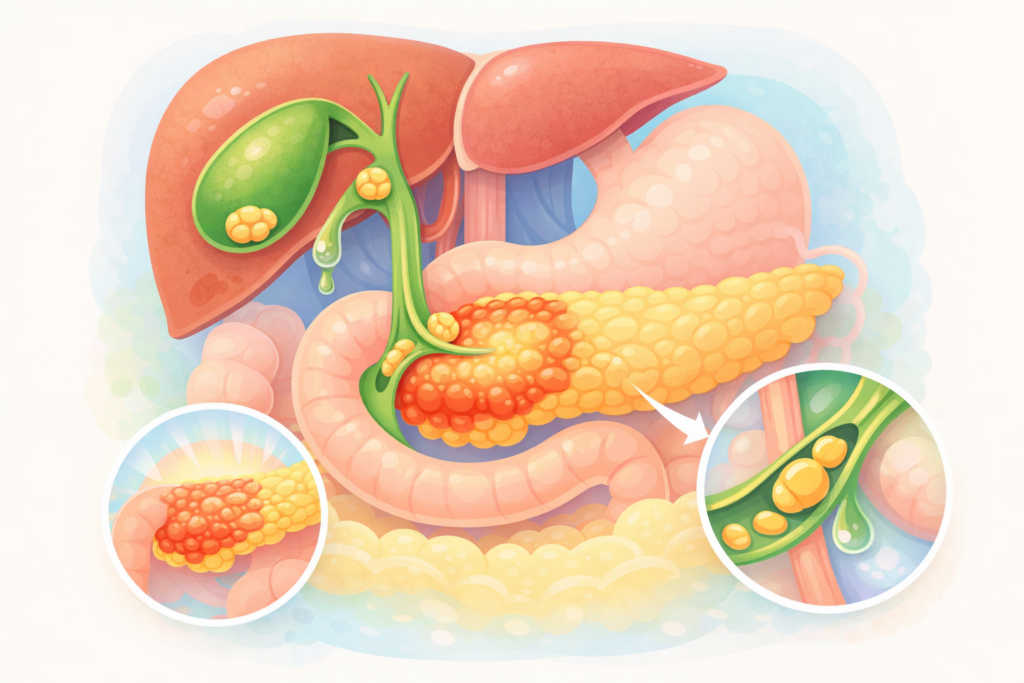

Recently, I came across a fascinating case report in the International Journal of Medical Students that described an unusual and rarely reported clinical association: Guillain-Barré syndrome (GBS) developing in a patient with acute biliary pancreatitis. At first glance, these two conditions seem completely unrelated, which is exactly why this case stood out to me.
GBS is a neurological condition that most of us associate with infections like Campylobacter jejuni or viral illnesses. Acute pancreatitis, on the other hand, is an inflammatory condition of the pancreas, commonly caused by gallstones. Seeing these two conditions intersect in a critically ill patient really made me think about diagnostic bias, especially in intensive care settings.
You can find the original case report here: https://ijms.info/IJMS/article/view/3896
What is the case about?
The paper describes a 67-year-old woman who was admitted with severe acute biliary pancreatitis. Her illness was complicated by multiple organ failure, including acute respiratory distress syndrome (ARDS) and acute kidney injury, requiring ICU admission and mechanical ventilation.
After she was extubated, clinicians noticed something unexpected: she was unable to lift her arms or legs against resistance. Her reflexes were absent, but sensation was intact. Initially, this presentation could easily be explained as critical illness polyneuropathy, a common complication in ICU patients.
However, further investigations, including nerve conduction studies and electromyography, revealed that she actually had the acute motor-sensory axonal neuropathy (AMSAN) variant of GBS. Despite treatment with plasma exchange, her condition continued to deteriorate, and unfortunately she did not survive.
Why did this catch my interest?
What really intrigued me about this case was how easily GBS could have been missed.
In critically ill patients, new-onset weakness is often named as due to prolonged immobility, sepsis, or ICU-related neuropathy. This case essentially proves how dangerous that assumption can be. Even though GBS is typically linked to infections, this report suggests that severe inflammatory conditions like pancreatitis could also trigger immune-mediated neurological damage.
I also found it interesting that the cerebrospinal fluid results were not classically diagnostic for GBS, showing that clinicians cannot rely on one test alone. Instead, the diagnosis depended heavily on electrophysiological studies, showing how important thorough investigation is over settling for the most obvious explanation.
Why does this matter in healthcare?
From a clinical perspective, this case emphasises an important rule: not all ICU-acquired weakness is the same.
GBS is a medical emergency, and evidence shows that treatments such as plasma exchange are most effective when started early. Delayed diagnosis can significantly worsen outcomes. If clinicians automatically assume critical illness polyneuropathy, they may miss the window where treatment could be life-saving.
On a broader level, this case also makes me curious about the immune mechanisms behind pancreatitis and whether systemic inflammation could act as a trigger for autoimmune neurological conditions. It shows how interconnected different body systems are, and why medicine often requires thinking beyond traditional disease boundaries.
Reflections
Reading this case made me think about how complex real-life medicine is compared to school learning. Conditions don’t always present in obvious ways. This shows the importance of keeping a broad differential diagnosis, especially when patients are not improving as expected.
It also made me appreciate how valuable case reports are. Even though they involve a single patient, they can alert clinicians worldwide to rare but serious associations, potentially improving future patient care.
Questions I’m still thinking about
This paper left me with a few questions:
- Could acute pancreatitis act as a trigger for other autoimmune neurological conditions?
- Should ICU protocols place more emphasis on early neurological assessment after extubation?
- How can clinicians better differentiate between critical illness polyneuropathy and GBS early on?
Anyway, thank you so much for reading! If you have any questions or feedback, drop a comment below! 🙂
– Written by Hamd Waseem (14)
Reference
Arshad, S., Iftikhar, H., & Ilyas, M. (2025). Guillain–Barré Syndrome in the Setting of Acute Biliary Pancreatitis: A Rare Clinical Association. International Journal of Medical Students, 13, S278. https://doi.org/10.5195/ijms.2025.3896