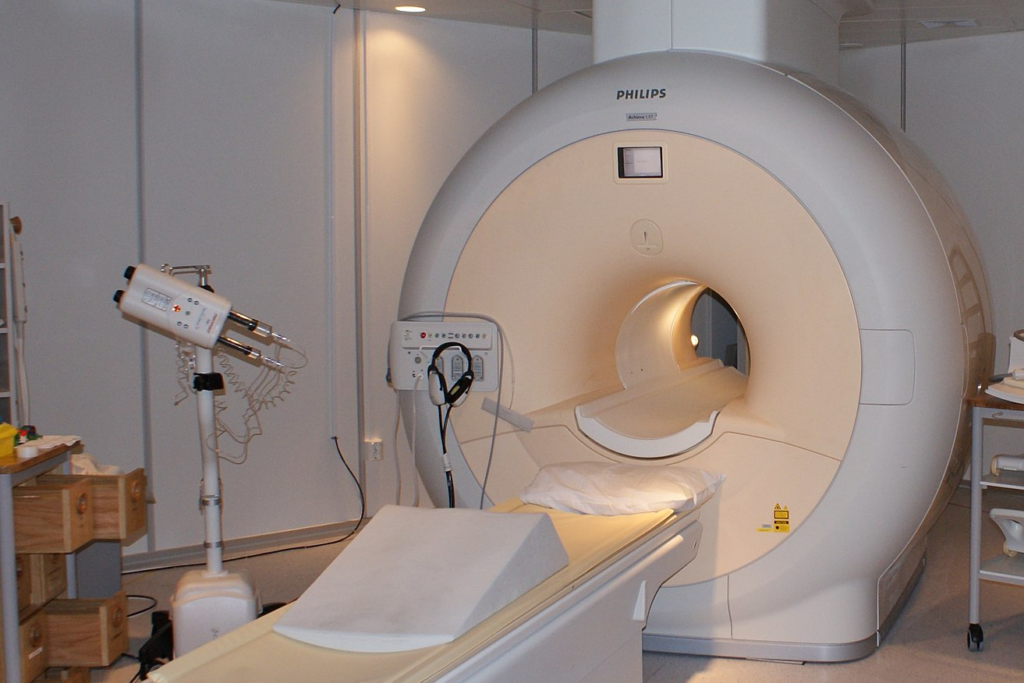

So, you’ve probably seen an MRI machine in a movie or a hospital. It’s that giant, noisy doughnut-shaped tube that people slide into. But have you ever wondered how a massive magnet can create a detailed picture of your organs without even touching them?
Well it’s not magic, and it’s not even x-rays – so there’s zero radiation, unlike popular belief!
Permanent vs Induced Magnetism

Before we understand how MRI scanners work, we need to understand how things become magnetic even when they normally aren’t.
Think about it – fridges aren’t always magnetic. But if you bring a fridge magnet towards it, it’ll stick on.
Inside the fridge’s material, the atoms contain electrons that have their own spin, each acting like a tiny, spinning bar magnet. Normally, they are all misaligned, and they cancel each other out, so overall the fridge has no magnetic field.
But when you bring an object with its own magnetic field (or as we call it, a permanent magnet), the electron spins line up, creating regions where their magnetic fields line up, These are called domains.
Eventually, all the domains line up and the whole fridge has its own magnetic field. That’s why it can stick with the fridge magnet.
Why You Are The “Fridge” to an MRI Scanner
Ok – that heading probably made no sense, but let me explain 🙂
Your body is full of water. Water contains hydrogen atoms, which contain one proton in their nuclei. These protons act as the tiny spinning magnets, just like the fridge.
The MRI is an electromagnet, with a magnetic field thousands of times stronger than the Earth’s.
It’s so strong that it forces the protons in your body’s water to line up and face the same direction.
The “Nudge” and the “Snap”
While you lie there, the machine sends a Radiofrequency (RF) pulse through your body. This is called the “nudge”. This pulse knocks the protons out of alignment, making them wobble (precess) sideways around the magnetic field.
When the RF pulse is turned off, the protons don’t just stay there. They have a tendency to get back to their original position.
As they “snap” back into alignment with the big magnet, they release a tiny bit of energy in the form of a radio signal.
The interesting part is that protons in different tissues snap back at different speeds! Protons in fatty tissue snap back much faster, and protons in water or blood take much longer to snap back.
The MRI’s computer listens to these signals. By measuring how long it takes for the protons to “relax” in different parts of your body, the computer can tell exactly what kind of tissue it’s looking at. It then maps these signals into a high-definition, 3D image.
T1 and T2 Images
In a medical physics exam, you’ll often hear about T1-weighted and T2-weighted images. These are just different ways of timing the “snap back” to highlight different things: T1 images are great for looking at anatomy (fat looks bright) and T2 images are great for finding disease or swelling (water/fluid looks bright).
Cool. Why Do We Care?
The MRI is one of the most powerful tools in modern medicine because it provides incredible detail of soft tissues, like the brain, spinal cord, and ligaments, which X-rays usually miss.
Because it uses magnets instead of ionising radiation, it’s much safer for repeated use. It allows doctors to “dissect” a patient virtually, finding tiny tumors or torn ACLs without a single incision.
So there you go! MRI physics in a nutshell. If you have any questions about how the coils work or what that loud banging noise is, drop a comment below! Thanks for reading!
– Hamd Waseem (14)
Featured Image – https://commons.wikimedia.org/wiki/File:MRI-Philips.JPG