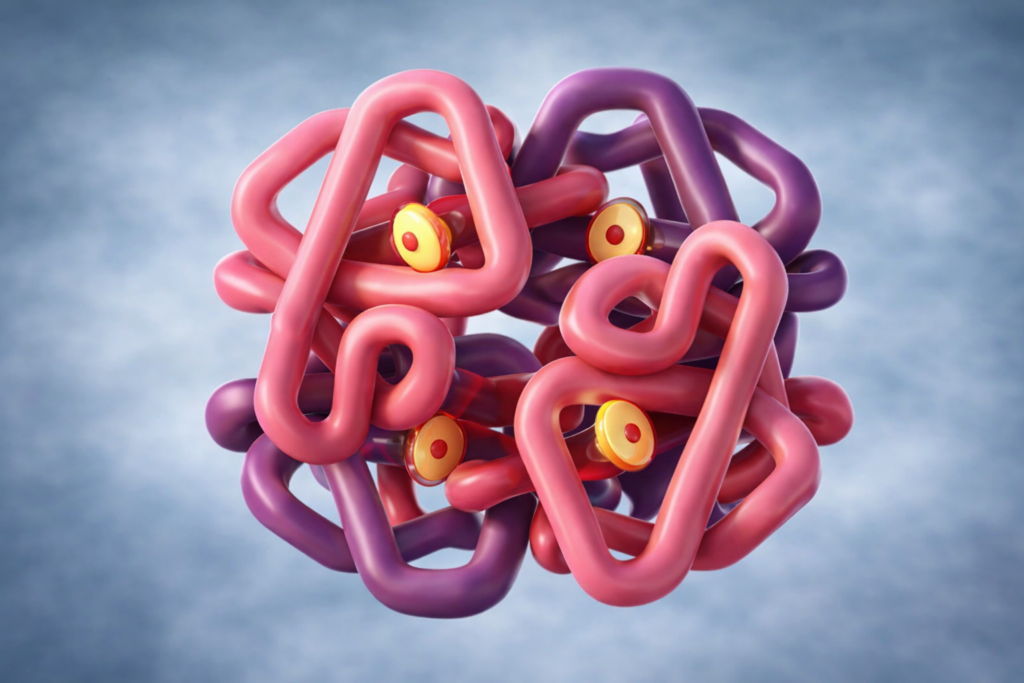

So you probably know what haemoglobin is (or hemoglobin for the American readers out there :D) – it binds to oxygen in the blood. Why? To drop it off at muscles and body parts that need it.
But…. how?
It’s not like haemoglobin has a brain – it can’t see when your quads are tired to drop off some oxygen.
Well it turns out – haemoglobin isn’t just a mindless delivery van. It’s actually quite ‘smart.’ There’s an indicator that tells it exactly when to tighten its grip on oxygen and when to let go. This is the Bohr Effect.
What happens when you do hard work?
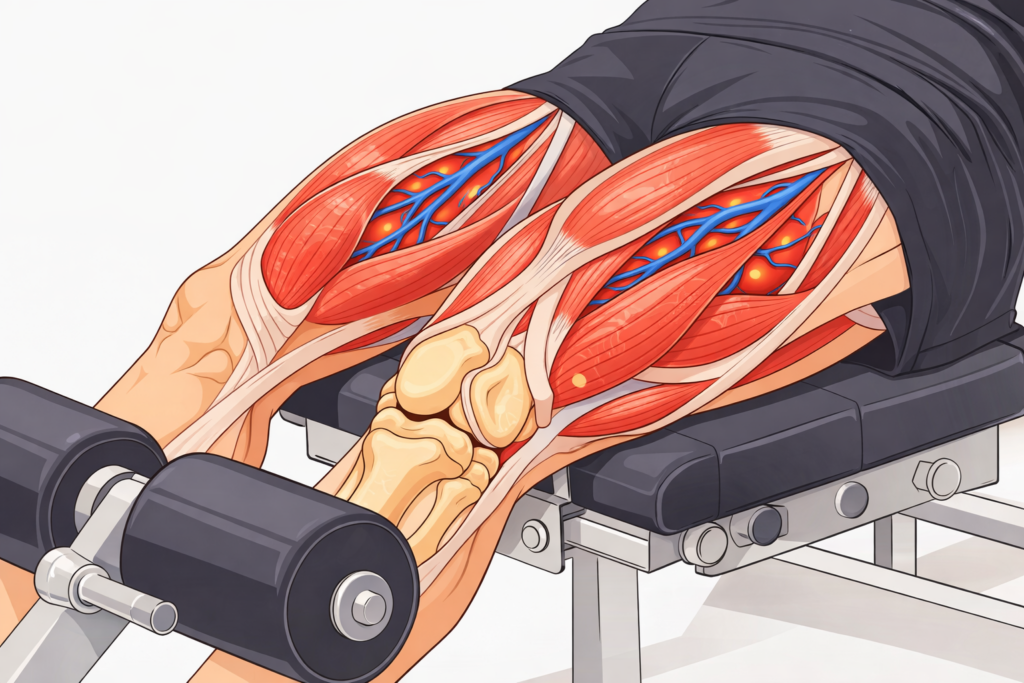
You know that feeling in muscles when you work out too much? The soreness?
That is mainly from a release of lactic acid, when your muscles begin respiring anaerobically. Carbon dioxide and heat also gets released.
Lactic acid contians hydrogen ions (H⁺) as it is an acid. And when carbon dioxide dissolves in water, it forms carbonate ions that can become carbonic acid, which also has hydrogen ions!
These three products – carbon dioxide, hydrogen ions, and heat – are called metabolic byproducts, and they are always released whenever a muscle is working hard.
So what does that have to do with haemoglobin?
Haemoglobin’s R-State and T-State
In 1904, Christian Bohr discovered that those metabolic byproducts act as a chemical signal, and haemoglobin’s structure actually changes when it detects them.
Haemoglobin actually exists in two main states, the R-State and the T-State.
R-State or “relaxed state” is where haemoglobin has a high affinity for oxygen. It remains bonded very well. This happens when there is low carbon dioxide, i.e. in the lungs.
The T-State (tense state) is the opposite – it has a tendency to drop off oxygen. This occurs where carbon dioxide and hydrogen ions are in higher concentration, so in the muscles!
When carbon dioxide and hydrogen ion levels rise in a tissue, they bind to the haemoglobin molecule (not at the site of the oxygen!) and this stabilises the molecule into the T-State. This causes the haemoglobin to dump the oxygen where the concentration of metabolic byproduct is greatest.
Visualising the Shift
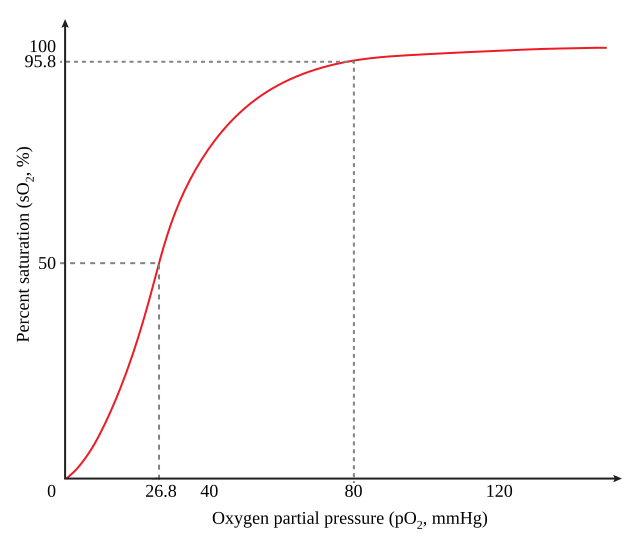
This graph is called an “Oxygen-Haemoglobin Dissociation Curve” and it’s very common to find in a physiology exam.
When the Bohr effect kicks in, the curve shifts to the right. A right shift means that for any given amount of oxygen available, the haemoglobin is less saturated – as in it drops off its oxygen.
A great mnemonic to remember exactly what causes the right shift, is “CADET, Face right!”
- Carbon Dioxide (Increase)
- Acid (More Hydrogren Ions)
- 2,3-DPG (A molecule produced during glycolysis)
- Exercise
- Temperature (increase)
Cool. Why Do We Care?
The Bohr Effect is the reason we can sustain high-intensity exercise. It ensures autoregulation. Your body doesn’t deliver oxygen equally to every tissue; it prioritizes the ones that are working the hardest and therefore producing the most waste.
Without this effect, your muscles would suffocate even if your blood was saturated with oxygen, because the haemoglobin would never let its oxygen go.
So there you go! The Bohr Effect but bitesized! If you have any questions, don’t hesitate to comment down below – thanks for reading 🙂
– Written by Hamd Waseem (14)